
Recent Blog
5 Reasons Every Adult in the Household Should Have Their Own Remittance Account
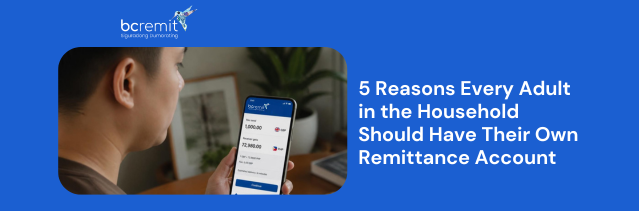
For many overseas Filipino workers, sending money home is part of everyday life. You may send money to your spouse for household expenses, to your parents for medicine and bills, or to siblings who are still studying. In some families, one remittance account becomes the default account for everyone. It seems easier: one person signs up, everyone uses it, and the family already knows how the process works.
But as your household grows and financial responsibilities become more complicated, sharing one remittance account can create unnecessary confusion. Even when everyone trusts each other, having separate remittance accounts can make managing money simpler, clearer, and more practical.
For OFWs using services such as BCRemit, encouraging every adult in the household to maintain their own account can help make family finances easier to organize. Here are five reasons why you should get your own remittance account, even if someone else in your household has one!
1. Everyone Gets a Clearer Record of Their Own Transactions
When several adults rely on the same account, it can become difficult to remember which transaction belonged to whom. Was that transfer for your mother’s medical expenses? Did your spouse already receive the money for the electricity bill? Was the last transaction meant for household groceries or your sibling’s tuition?
When every adult has their own remittance account, transaction records stay associated with the person who actually sent or received the money. That creates a much clearer financial history.
For an OFW managing several responsibilities from abroad, this can be especially helpful. You may already be keeping track of your salary, rent, savings goals, insurance, loan payments, and expenses back home. You do not need another layer of confusion caused by multiple family members sharing one account.
Separate accounts make it easier for everyone to check their own activity instead of asking one family member to reconstruct what happened weeks or months later. It is a small change that can make household budgeting much easier.
2. You Do Not Have to Depend on One Person
Many OFW households naturally have one person who becomes the family’s financial coordinator. Maybe your spouse handles most expenses while you are abroad. Maybe your mother receives your remittances and distributes the money among different relatives. Or perhaps an older sibling became responsible for the family account simply because they were the first person to create one.
That arrangement may work well most of the time. The problem appears when that person is unavailable. They may be at work, traveling, dealing with a family emergency, or simply unable to access the account when money is urgently needed.
If every adult has their own remittance account, the entire household does not have to rely on one person. Your spouse can manage their transactions independently. Your parents can receive or handle money intended specifically for them. Other adults in the household can take responsibility for their own financial needs.
For OFWs, this creates greater flexibility. You are no longer building your family’s entire remittance system around one account holder.
3. Separate Accounts Encourage Better Financial Responsibility
Money management becomes easier when people can clearly see what belongs to them. Imagine sending your spouse money for household expenses while also sending your parents a separate amount for medicine and utilities.
If everything passes through one account, those funds can easily feel like one large pool of money. But when adults maintain their own accounts, financial responsibilities become more clearly defined.
Your spouse can track the household budget. Your parents can monitor the money you send for their needs. Adult children or siblings can manage funds and start allocating savings intended specifically for them.
That does not mean families should stop helping one another. It simply creates better visibility.
For many OFW families, this can also make conversations about money easier. Instead of asking, “Where did the money go?” everyone has a clearer view of the transfers they were responsible for managing.
Over time, this can encourage better budgeting habits and greater accountability across the household.
4. Privacy Still Matters, Even Within Families
Filipino families are often very close, particularly when it comes to finances. But being close does not mean every adult needs access to every financial transaction.
Your spouse may have expenses that are different from your parents’ expenses. Your parents may receive money for medical needs that do not need to appear alongside other household transactions. An adult sibling may have their own financial responsibilities.
Separate remittance accounts give each person more privacy over their own financial activity. This can become increasingly important as families change.
Children become adults. Parents retire. Siblings start their own households. Couples develop individual savings goals alongside shared expenses.
Having separate accounts allows each adult to manage their own transactions and save on remittances while still remaining part of the family’s broader financial plan. You can still support each other, but you simply do not have to combine every financial activity into one account to do it.
5. It Makes Your Family’s Financial Setup More Flexible
OFW life can change quickly. You might move to another country for work. Your spouse may start a business. Your parents may need more regular support. An adult child may begin university or start managing their own expenses.
When everyone relies on one remittance account, every change has to revolve around the same account holder. Separate accounts make it easier for your family’s financial system to adapt. Instead of reorganizing everything whenever responsibilities change, each adult already has a way to manage their own remittance activity.
That flexibility can be useful both for everyday transfers and unexpected situations. If one family member suddenly needs money, you can send it directly to the appropriate person instead of routing everything through whoever happens to control the household account.
The goal is not to make family finances more complicated; in fact, it is exactly the opposite. A good remittance setup should make sending, receiving, and tracking money as straightforward as possible.
One Family Does Not Have to Mean One Account
When you are working overseas, you already carry a lot of responsibility. You are earning money far from home while trying to make sure the people you care about have what they need.
Sharing a remittance account with your spouse or parents might seem convenient, particularly if that is how your family has always handled money. But convenience today can become confusion later. Create your own BCRemit account today and make managing remittances simpler for you and your family.
Download the BCRemit app from the Apple App Store or Google Play, sign up in minutes, and give every adult in your household a clearer, more flexible way to manage money sent home.
Subscribe to our Newsletter
Our Global Presence
🌐 Online Services Available Open 24/7
-
Sunday: Open 24 hours
-
Monday: Open 24 hours
-
Tuesday: Open 24 hours
-
Wednesday: Open 24 hours
-
Thursday: Open 24 hours
-
Friday: Open 24 hours
-
Saturday: Open 24 hours