
Recent Blog
Cash Pickup vs. Bank Deposit: The Pros and Cons of Each Remittance Option
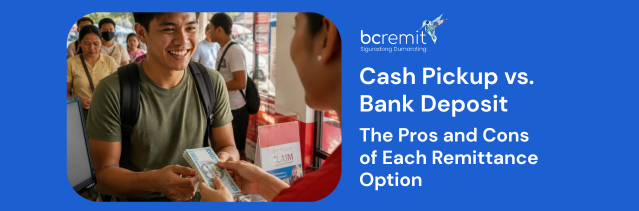
When sending money to the Philippines, choosing a remittance provider is only part of the decision. You also need to think about how your recipient will receive the money.
Two of the most common options are cash pickup and direct bank deposit. Both can be convenient, but they suit different situations. A parent living far from a bank may prefer to collect cash locally, while a spouse who pays bills electronically may find a bank deposit remittance much easier.
Understanding cash pickup vs. bank deposit can help you choose the option that gives your family the right balance of speed, convenience, security, and accessibility. Here is what to consider before your next transfer.
What Is Cash Pickup Remittance?
With cash pickup, you send money through a remittance provider and your recipient collects the funds in cash from an available payout location in the Philippines.
Depending on the provider, recipients may need to present identification and information connected to the transfer before the money can be released.
Remittance cash pickup in the Philippines can be particularly useful for recipients who:
- Prefer using cash
- Do not have a bank account
- Live near an accessible payout location
- Need physical money for immediate expenses
- Are less comfortable using mobile or online banking
For some households, cash remains the simplest way to manage everyday spending.
Pros of Cash Pickup
1. No bank account may be required
One of the biggest advantages of cash pickup is accessibility. Not every recipient has a bank account, particularly elderly relatives or people living in areas where banking services are less convenient. Cash pickup allows them to receive family support without opening or managing an account.
2. The recipient gets physical cash
For expenses that need to be paid in person, receiving cash can be convenient. Your recipient may use the money immediately for groceries, transport, household purchases, or other everyday expenses.
3. It can provide another option during urgent situations
If a recipient cannot access their bank account or has a problem with their card, an available cash pickup option may provide an alternative way to receive funds. Always check the estimated availability of the specific transfer before assuming it will be immediate.
Cons of Cash Pickup
1. Your recipient has to travel
Cash does not arrive directly to the recipient. They may need to travel to a payout location, wait in line, present identification, and collect the money during the location’s operating hours.
That can be inconvenient for someone who lives far away, has limited mobility, or works during the day.
2. Carrying cash creates additional risk
Once the money is collected, the recipient is responsible for carrying and storing it. For a larger transfer, travelling home with a significant amount of cash may be less desirable than having the money deposited securely into an account.
3. Opening hours can matter
A cash pickup location may not always be available when your recipient needs the money. Weekends, holidays, local closures, and operating hours can all affect accessibility. Before sending an urgent transfer, check when and where the recipient can actually collect it.
What Is Bank Deposit Remittance?
With a bank deposit remittance, the money is transferred directly into your recipient’s Philippine bank account. Instead of visiting a payout location, the recipient receives the funds electronically.
This can be convenient for family members who already use their accounts for bills, savings, online purchases, card payments, or ATM withdrawals. You will generally need accurate recipient bank information when creating the transfer.
Pros of Bank Deposit
1. It is convenient for the recipient
The biggest advantage is simple: there may be nothing for the recipient to collect. Once the transfer reaches the account, the money can be accessed through the bank’s normal services. That can save time and travel.
2. It makes digital payments easier
If your recipient regularly pays electricity, internet, tuition, insurance, loans, or other expenses electronically, receiving the money directly into a bank account can make managing those payments easier. There is no need to receive cash and then deposit it again.
3. It may be better for savings
Cash is easy to spend. If part of your remittance is intended for savings, an emergency fund, tuition, or another long-term goal, depositing it into an appropriate account can help separate that money from daily household cash.
4. There is less need to carry large amounts
For larger transfers, bank deposit can reduce the need for a family member to travel while carrying cash. The funds remain within the banking system until your recipient decides how much they need to withdraw or spend.
Cons of Bank Deposit
1. Your recipient needs a suitable account
Bank deposit obviously will not work if the person you are supporting does not have an account with a supported institution. That makes cash pickup potentially more accessible for some families.
2. Incorrect details can cause problems
You need to enter recipient information carefully. Before sending, double-check details such as:
- Recipient name
- Bank
- Account number
- Other information requested by the transfer provider
A simple typing mistake may delay a transfer or require additional help to resolve.
3. Processing times can vary
A bank deposit does not automatically mean the money will appear immediately. Transfer timing can depend on the remittance provider, the recipient bank, the time the transaction was submitted, weekends, holidays, and whether additional verification is needed.
Always review the expected delivery time shown before confirming.
Cash Pickup vs Bank Deposit: Which Is Better?
There is no single winner in the cash pickup vs. bank deposit comparison. The better choice depends on your recipient.
Cash pickup may make more sense when:
- Your recipient does not have a bank account
- Cash is their preferred way to manage money
- A pickup location is conveniently located
- They need physical cash for local expenses
Bank deposit may be more suitable when:
- Your recipient already uses online or mobile banking
- Most bills are paid electronically
- The transfer is intended partly for savings
- Travelling to collect cash would be inconvenient
- You are sending a larger amount
Ask your family what works best for them rather than assuming one method is always more convenient.
Think About the Purpose of the Remittance
You also do not necessarily need to choose the same payout method every time. The purpose of the money can help guide your decision.
If you are sending funds for a household emergency where physical cash is useful, cash pickup may be practical. If you are sending money for a mortgage payment, tuition, savings, or bills that will ultimately be paid electronically, sending directly into a bank account may reduce unnecessary steps.
Matching the transfer method to the expense can make remittance easier for everyone.
Compare the Complete Transfer
Payout method is important, but it should not be considered in isolation. Before confirming a transfer, look at:
- Exchange rate
- Transfer fee
- Final amount received
- Expected delivery time
- Available payout methods
- Convenience for your recipient
The cheapest option is not necessarily the best if collecting the money creates a major inconvenience for your family. Likewise, the fastest option may not be necessary for a transfer planned several days in advance.
Ask Your Recipient Before Sending
One of the easiest ways to avoid problems is simply to ask. Before sending a larger remittance, confirm:
- Which payout method they prefer
- Whether their bank details are current
- Whether their identification is valid for cash pickup
- Whether they can easily reach the payout location
- When they actually need the money
Your family member is the person who ultimately has to access and use the funds. Convenience for the sender should not create unnecessary work for the recipient.
Choose the Right Way to Send with BCRemit
Whether your family prefers a bank deposit remittance or another available payout option, the goal is the same: getting your hard-earned money home simply and reliably.
Filipino-owned and trusted for over a decade, BCRemit helps customers in the UK, Canada, the US, and the EU send money to the Philippines with competitive exchange rates, clear fees, and a straightforward transfer process.
Before sending, review your available transfer options, recipient information, fees, and expected delivery details so you can choose the method that works best for your family.
Whether you are helping with everyday expenses, saving toward a family goal, or sending support during an unexpected situation, choosing the right payout method can make your padala easier to manage at both ends.
Download the BCRemit app from the Apple App Store or Google Play, create your account, and choose the transfer option that works best for your family in the Philippines.
Subscribe to our Newsletter
Our Global Presence
🌐 Online Services Available Open 24/7
-
Sunday: Open 24 hours
-
Monday: Open 24 hours
-
Tuesday: Open 24 hours
-
Wednesday: Open 24 hours
-
Thursday: Open 24 hours
-
Friday: Open 24 hours
-
Saturday: Open 24 hours